
You found a home you want. Your offer was accepted. Now your agent is telling you to schedule a home inspection — and you’re wondering exactly what that means in Arizona.
It means something different here than it does in Ohio.
The East Valley has its own set of building practices, climate conditions, and failure patterns. An experienced home inspector in Gilbert, AZ knows what a summer AC unit looks like when it’s five years past its expected lifespan, what monsoon-driven water intrusion looks like on a flat roof, and what stucco condition tells you about how a structure has handled a decade of thermal cycling. Here is what Arizona buyers should expect.
What Does a Standard Arizona Home Inspection Include?
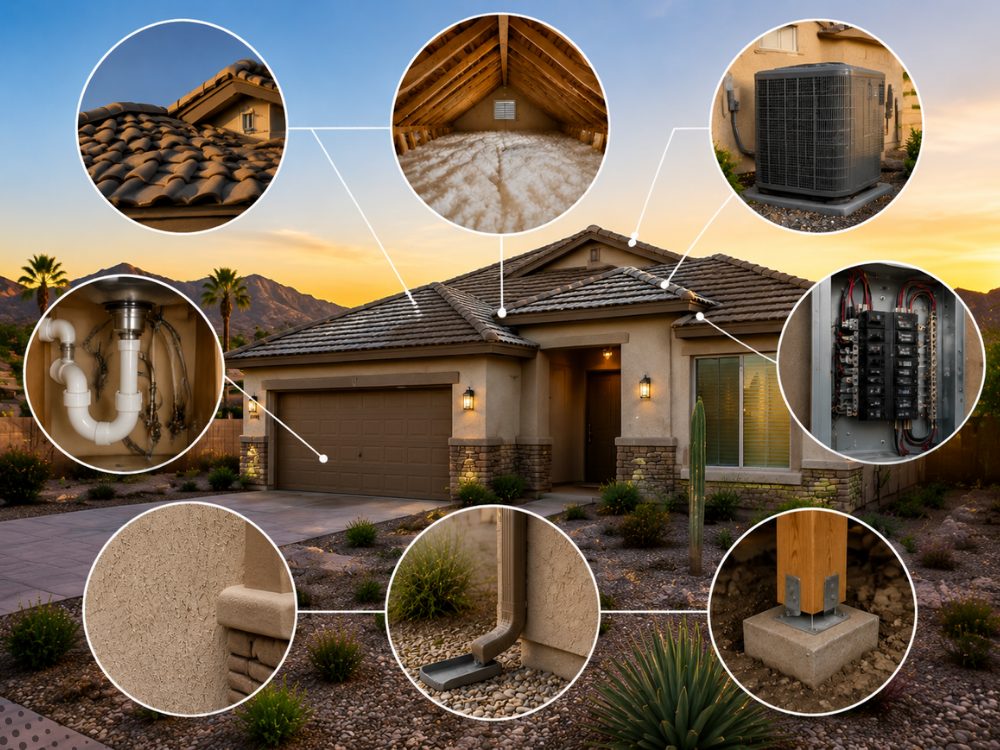
A standard home inspection is a visual evaluation of the home’s major systems and accessible components. In Arizona, that includes the roof and attic, the HVAC system, the electrical panel and visible wiring, the plumbing system, the foundation and structural components, and the exterior — including the stucco, grading, and drainage.
The inspection is non-invasive. The inspector does not open walls, move furniture, or operate systems in ways an ordinary homeowner would not. What they do is spend two to four hours methodically evaluating condition, function, and visible defects — and they document everything in a written report. (See a sample report.)
That report is one of the most important documents in your transaction. It tells you what you’re buying.
Why Does HVAC Deserve Extra Attention in the East Valley?
In most of the country, air conditioning is a seasonal appliance. In the East Valley, it is a year-round life-safety system. From roughly April through October, residential AC units in Gilbert, Chandler, Mesa, and Tempe run continuously — often 12 to 16 hours a day during peak summer.
That usage accelerates wear significantly. An AC unit that is 10 years old in Arizona has likely worked harder than a 15-year-old unit in a milder climate. During an inspection, age, condition, and visible signs of deferred maintenance all matter — but so does sizing. An undersized system for a given square footage will run constantly without achieving setpoint temperatures, shortening its life even faster.
When reviewing your inspection report, pay attention to the age of the unit, any noted refrigerant concerns, and whether the inspector flagged further evaluation by an HVAC technician. This is one area where a specialist consult before closing is often money well spent.
What Should Buyers Know About Flat Roofs in Arizona?
A significant portion of East Valley homes — especially in master-planned communities built in the 1990s and 2000s — have flat or very low-slope roof sections, often above garages, covered patios, or room additions. These sections require different materials and maintenance than pitched tile roofs, and they are more vulnerable to water intrusion if drainage systems fail.
After monsoon season, flat roofs should be checked for standing water, membrane blistering, cracked or deteriorated caulk around penetrations, and debris buildup in scuppers and interior drains. A good inspector will note condition, visible pooling patterns, and age of the membrane. If the flat roof section is original to a 20-year-old home, replacement may be approaching regardless of current visible condition.
Ask your inspector specifically about the flat roof sections. Do not assume a general “roof: satisfactory” notation covers them adequately. Our monsoon roof damage checklist covers what post-storm roof wear looks like here.
Is Monsoon Damage Something to Look for Year-Round?
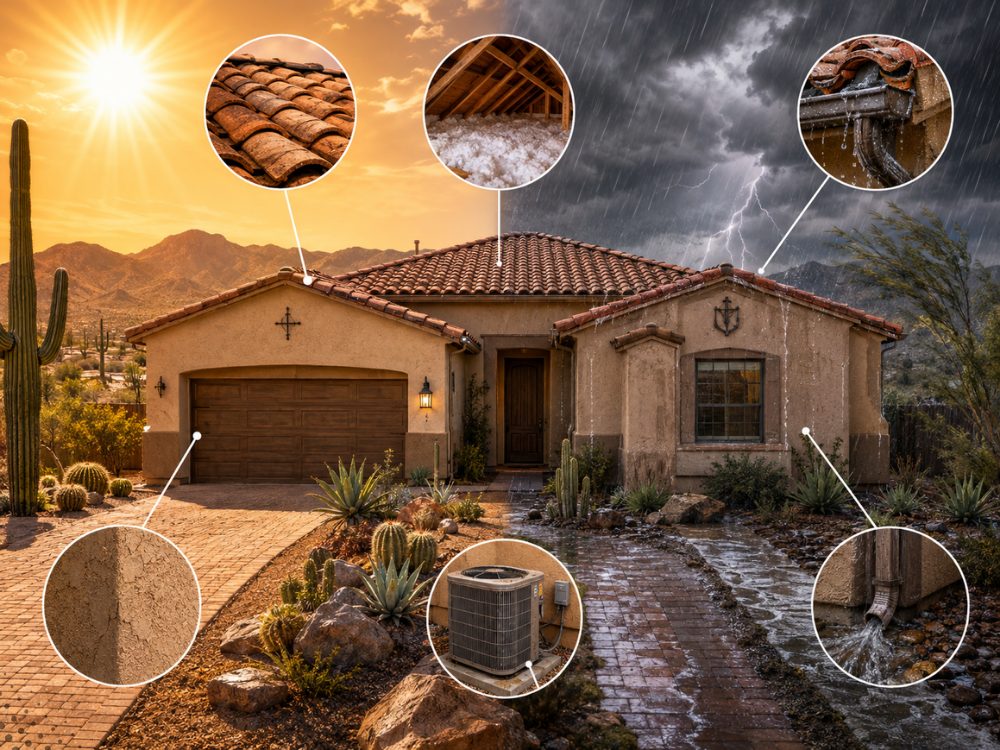
Yes — and if you are buying a home in September, you are shopping at peak monsoon damage season. Water intrusion from monsoon storms does not always show itself immediately. Moisture can sit in a wall cavity, attic, or subfloor for weeks before visible staining or odor develops.
An inspector examining a home in September should be paying attention to recent moisture evidence: staining on ceilings and walls, water marks at window and door frames, soft or discolored drywall near exterior walls, and any attic penetrations that show signs of recent weather intrusion. If a seller reports storm damage and recent repairs, ask for documentation and permits. Where moisture has been sitting, a mold inspection is the next step.
What Is a WDO Inspection, and Do Arizona Buyers Need One?
A WDO (Wood-Destroying Organism) inspection is a separate, specialized inspection performed by a licensed pest control operator — not part of the standard home inspection scope. In Arizona, termites are not a question of if but when. The East Valley is home to multiple species of subterranean and drywood termites, all of which are active, and all of which can cause significant structural damage that a standard inspection will not fully diagnose.
A WDO inspection is strongly recommended as a separate add-on. It specifically looks for evidence of termite activity, conducive conditions, moisture damage, and fungal decay. September falls within an active swarm and activity window for Arizona termite species, which makes this timing particularly relevant for fall buyers.
Budget for this as a separate cost, schedule it separately, and review both reports together before your inspection contingency deadline.
What About the Pool — Is That Part of the Home Inspection?
If the home you’re buying has a pool, that’s a specific conversation to have with your inspector upfront. Pool safety and equipment inspections are a separate scope — not part of a standard home inspection. Evaluating the pool barrier (fencing and gate hardware), the equipment pad, the plumbing, the surface condition, and electrical bonding requires a different protocol and, in many cases, a pool-specific inspector.
Ask your inspector whether they include pool safety and equipment as part of their inspection or whether you should schedule a pool inspector separately. In Arizona, this is worth knowing before you submit your offer — not after.
Ready to Schedule Your East Valley Home Inspection?
Leading Edge Plus Inspections serves buyers throughout Gilbert, Chandler, Mesa, Tempe, and Queen Creek. Call Kelly Lopez directly at (602) 581-5678 to check availability and get scheduled before your inspection contingency window closes.
The inspection is the one step in your transaction that’s working entirely for you. Use it.
Watch: Home Inspector Gilbert AZ
Frequently Asked Questions
What does a home inspection include in Arizona?
A standard Arizona home inspection covers the roof and attic, HVAC system, electrical panel and visible wiring, plumbing, foundation and structural components, and the exterior including stucco, grading, and drainage. It is a visual, non-invasive evaluation documented in a written report.
How long does an AC unit last in Arizona?
In the East Valley, AC units typically have a shorter effective lifespan than in cooler climates because they run nearly continuously from April through October. A 10-year-old unit in Gilbert or Chandler may have accumulated the equivalent wear of a 15-year-old unit elsewhere. Age, condition, and sizing are all evaluated during a home inspection.
Do I need a termite inspection when buying a home in Gilbert, AZ?
Yes. A WDO (Wood-Destroying Organism) inspection is strongly recommended for East Valley buyers. It is a separate inspection performed by a licensed pest control operator and covers termite activity, moisture damage, and fungal decay — areas outside the standard home inspection scope. Multiple termite species are active in the Gilbert and Chandler area.
Are flat roofs common in the East Valley, and what should buyers watch for?
Yes, flat and low-slope roof sections are common on East Valley homes, especially those built in the 1990s and 2000s. Buyers should ask specifically about flat roof condition, drainage, membrane age, and any standing water patterns noted during inspection. These sections require different maintenance than pitched tile roofs and are more vulnerable to monsoon water intrusion.
Is a pool inspection part of a standard home inspection in Arizona?
No. Pool safety and equipment inspection is a separate scope from the standard home inspection. Arizona buyers should ask their inspector whether pool inspection is included or whether a pool-specific inspector should be scheduled separately. This covers barrier safety, equipment condition, surface, plumbing, and electrical bonding.