
Your air conditioner has been running since April. Your roof just survived another monsoon season. Your attic hit 150°F in July. And most East Valley homeowners won’t look at any of it until something breaks.
September is the reset window — and if you wait until October, you’ve already missed the best weather and the lightest contractor schedules of the year. Here’s where to focus your attention right now.
What Roof Damage Should You Look for After Monsoon Season?
Monsoon season officially runs July through September in Arizona — and the storms it brings are not gentle. High winds, driving rain, and hail can pull up flashing, crack caulk seals around vents and pipes, and leave debris in gutters and downspouts that won’t reveal itself until the next rain event.
For East Valley homeowners, that means getting eyes on your roof as soon as the storm season quiets down. Walk your property after the next calm day and look for anything out of place: lifted shingles or loose tile, displaced ridge caps, or dark streaks that weren’t there in June. On flat-roof homes — and the East Valley has a lot of them — standing water after rain is a red flag. It means drainage is compromised, and standing water accelerates membrane degradation faster than heat alone. Our monsoon roof damage checklist walks through exactly what to look for.
If you’re not comfortable getting on the roof yourself, this is exactly the kind of thing a maintenance inspection is built for. Don’t wait for a leak to tell you there’s a problem.

Is Your AC Ready for Fall — and for Next April?
Here is what most homeowners don’t think about: September is not when Arizona’s AC season ends. It’s when you get your best chance to inspect and service the unit before it’s needed again in eight months. A system that ran almost continuously from April through September has earned a thorough look.
Common issues that surface after a long Arizona cooling season include coil fouling from dust and debris, clogged condensate drain lines, refrigerant that’s run low without any obvious sign, and capacitors that are weakening but haven’t failed yet. None of these announce themselves until you need the system most. (We covered why HVAC systems struggle in extreme heat earlier this year.)
Schedule your HVAC service call in September or early October, before every other homeowner in Gilbert and Chandler waits until next March and clogs every technician’s calendar. An inspection-flagged system gives you specifics — not just “it’s working” but documentation of what’s working, what’s aging, and what’s worth watching.
How Does Desert Heat Affect Your Stucco — and Why Does It Matter?
Stucco is the dominant exterior finish in the East Valley for good reason — it’s durable, relatively low-maintenance, and looks right at home in the desert. But thermal cycling — the daily swing between extreme daytime heat and cooler nights — is hard on any material that expands and contracts repeatedly over years. In Arizona, that swing can span 40 degrees or more in a single day during shoulder seasons.
After a full summer of triple-digit days, September is a good time to walk the perimeter of your home and look at stucco condition with fresh eyes. Small hairline cracks are normal and cosmetic — the kind every stucco home develops over time and can be sealed with a simple caulk repair. But wider cracks — especially at window and door corners, where stress concentrates — can allow moisture to enter the wall assembly. In the desert, that sounds counterintuitive, but monsoon moisture plus compromised stucco is a real combination. (More on how Gilbert’s climate impacts foundations, stucco and concrete.)
Caulk and paint can mask a lot. A trained eye looks at what’s behind the surface presentation — at the pattern, width, and location of cracks rather than just whether the surface looks fresh.
What Happens in Arizona Attics — and Should You Be Worried?
In a summer like this one, your attic likely reached temperatures north of 150°F on the hottest days. At those sustained temperatures, fiberglass and cellulose insulation compresses over time, reducing its R-value — meaning the thermal barrier between your attic and your living space gets thinner every year. Radiant heat bleeds down into the living space, making your AC work harder. And any roof penetrations — vent boots, pipe collars, exhaust ducts — are under constant thermal stress that loosens seals and can create gaps.
September is a reasonable time to have someone confirm your attic insulation is still performing. In newer homes, this is less urgent. In homes more than 10 to 15 years old, it’s worth verifying. The payoff isn’t just comfort — it’s energy costs, and in Arizona, those are real numbers. An insulation deficiency that goes unaddressed in September will cost you every day from April through October next year.
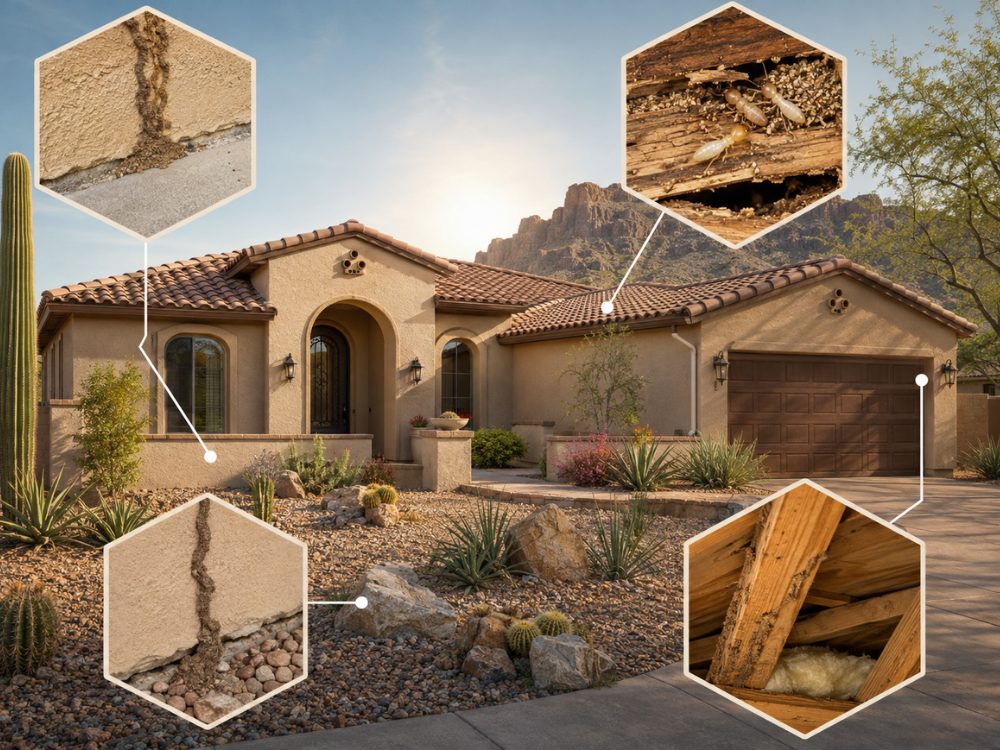
Should East Valley Homeowners Be Thinking About Termites Right Now?
Yes — and the timing matters. Termite swarm season in Arizona runs roughly February through May for subterranean species and July through October for Formosan and drywood populations. September sits right in that late-summer active window.
If your home hasn’t had a Wood-Destroying Organism (WDO) inspection in the last year or two, now is a smart time to schedule one — separate from a general home inspection, with a licensed pest inspector. WDO inspections look specifically at signs of termite activity, moisture damage, fungal decay, and other wood-destroying organisms that a general inspection is not scoped to diagnose in detail. Think of it as a specialist consult for one of Arizona’s most costly silent threats.
Ready to Tackle Your September Checklist?
You don’t have to manage this alone. A maintenance inspection gives you a documented, professional assessment of your home’s current condition — roof, AC, attic, stucco, and more — before the fall season kicks in.
Call Kelly at Leading Edge Plus Inspections: (602) 581-5678. We serve Gilbert, Chandler, Mesa, Tempe, and Queen Creek — and September is one of our best windows to get you scheduled quickly.
Watch: September Home Maintenance for Gilbert AZ Homeowners
Frequently Asked Questions
What home maintenance should I do after monsoon season in Arizona?
After monsoon season in Arizona, homeowners should inspect their roof for lifted shingles, cracked flashing, and debris in gutters and downspouts. Flat-roof homes should check for standing water that signals drainage problems. It's also a good time to service the AC, inspect stucco for stress cracks, check attic insulation, and consider a WDO termite inspection.
How does Arizona heat affect attic insulation?
Arizona attics can exceed 150°F during summer. Sustained high temperatures cause insulation to compress over time, reducing its R-value and making the AC system work harder. Homes more than 10 to 15 years old benefit most from having attic insulation professionally evaluated in the fall.
Should I get a termite inspection in September in Gilbert, AZ?
Yes. September falls within the active window for late-summer termite swarms in Arizona. A Wood-Destroying Organism (WDO) inspection — performed separately by a licensed pest inspector — checks for termite activity, moisture damage, and fungal decay. It is a recommended add-on for East Valley homeowners who haven't had one in the past year or two.
What is a home maintenance inspection?
A home maintenance inspection is a professional assessment of your home's current condition, performed outside of a real estate transaction. It documents the state of major systems — roof, HVAC, attic, structure, and exterior — so homeowners can prioritize repairs and maintenance before problems become costly.
When is the best time to service your AC in the East Valley?
September and early October are ideal for AC service in the East Valley. The unit has just completed its longest and hardest run of the year, and scheduling before the spring rush gives you access to technicians without the wait. A post-season service call can catch weakening capacitors, clogged drain lines, and refrigerant issues before they become emergencies.